- We Perform Inspections In The Counties of Flagler, St. Johns, Duval & More! | Schedule An Inspection Today!
- (386) 283-6548

H-Clips for Inspectors

by Nick Gromicko, CMI® and Kenton Shepard
H-clips, also called panel-edge clips, are small steel devices that fit snugly between wood panels in order to provide them with edge support. They are often used with roof sheathing to keep it from feeling spongy or soft at its edges. Their size should match the thickness of the panels to which they are attached. Determination as to whether they are required in construction varies by jurisdiction, but they are often helpful in situations where they are not required.
What are the benefits of using H-clips?
- H-clips increase panel stiffness by allowing distribution of weight between adjacent panels. A panel is less likely to deflect when subjected to a heavy load near its edges if it is made stiffer. This stiffening is particularly helpful for very thin panels (such as 3/8” inch) that are especially prone to bowing under heavy weight near their edges.
- The use of H-clips reduces the amount of required materials and lowers the cost of construction. A builder who uses H-clips may need fewer rafters to complete a project because the distance between them can be increased. H-clips may also allow builders to use thinner sheathing than they otherwise would be permitted to use. In either case, the cost of the job is reduced.
H-clips do not prevent wooden panels from buckling or warping. To the contrary, panels are more likely to buckle or warp when their room for expansion is limited, as is the case where H-clips are installed and panels are effectively connected to each other.
Where are H-clips required?
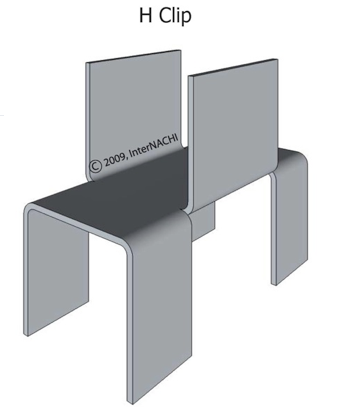
The 2006 edition of the International Residential Code (IRC) requires the use of H-clips in construction, but not all jurisdictions comply with IRC regulations. For instance, Jackson, Miss., complies with the IRC while Harrison, Miss., does not. Some homes in jurisdictions that currently require H-clips were built before the IRC required them and are not in violation of code. Other homes were built before their jurisdictions adhered to IRC requirements. However, since InterNACHI standards of practice are limited to safety and system defects, it is not necessary for inspectors to determine whether a lack of H-clips constitutes a code violation.
A lack of H-clips should not be noted as a defect unless:
- construction plans reveal that their use is required. Keep in mind that inspectors will probably never see these plans.
- the inspector knows for a fact that they were required in a building’s jurisdiction at the time of construction.
In either of these situations, inspectors should note the absence of H-clips in their reports.
In summary, H-clips have the ability to decrease deflection in wood panels and reduce the costs required by a building project. Inspectors should be concerned with safety and system defects that result from the lack of H-clips, but should not become encumbered by various code requirements.


